
The talks between India and China on the border row in eastern Ladakh have helped 'build trust' and the situation in the region has been normal since the disengagement in the Pangong Tso areas in February, Chief of Army Staff General M M Naravane said on Thursday, exuding confidence of resolution of the 'remaining issues'.

Before assuming charge of the CDS, Gen Chauhan paid tributes to India's fallen soldiers at the National War Memorial in the India Gate complex.
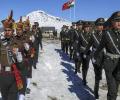
The external affairs minister, delivering the Sardar Patel Memorial lecture, also made it clear that any attempt to unilaterally change the status quo of the Line of Actual Control (LAC) is 'unacceptable' to India.
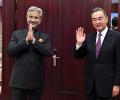
China is ready to take "conciliatory steps" in order to avoid new violations of the obligations on the India-Chinese border, Chinese Foreign Minister Wang Yi said on Friday, a day after holding a crucial meeting with External Affairs Minister S Jaishankar over the current standoff in Ladakh. Speaking during a joint press conference with Russian Foreign Minister Sergey Lavrov, Wang said troops and equipment should be withdrawn from the Line of Actual Control (LAC).

The Indian Army started bringing the T-90 Bhishma and T-72 Ajay tanks along with the BMP series Infantry Combat Vehicles from the deserts and plains in a big way to these high altitude locations from last year with the beginning of the Operation Snow Leopard to counter the Chinese aggression in eastern Ladakh last summer.

The defence minister said Prime Minister Narendra Modi and Chinese President Xi Jinping had an informal summit meeting at Wuhan where it was decided that peace and tranquillity will be maintained at the border.
The SC refused to entertain the plea that alleged that union minister V K Singh committed a breach of oath by giving statements with regard to India's official position on the LAC with China.

The heightened state of alert was only relaxed after Wang met his Jaishankar in Moscow on Friday on the sidelines of the Shanghai Cooperation Organisation summit, a second source said.
In the 15-year dataset, the researchers noted an average of 7.8 incursions per year even though the Indian government's estimates are much higher.

External Affairs Ministry Spokesperson Anurag Srivastava said China's claim over Galwan Valley was not in accordance with its own position in the past, noting that attempts of transgression by Chinese side were invariably met with appropriate response from the Indian troops.
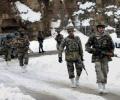
China has alleged that the Indian troops twice crossed the border line on June 15 for "illegal activities and provoked and attacked Chinese personnel" which led to serious physical conflict between the two sides, hours after the Indian Army said the violent face-off took place between the troops during the "de-escalation process" in the Galwan Valley.

The army chief said that India needs to broaden its understanding of national security and must examine non-traditional threats like pandemics "de-novo" as they have the potential to inflict severe damage on the country. "We need to act and prepare ourselves accordingly."

Lt Gen Kalita also stated that the Army is constantly monitoring the activities across the border and is well prepared to meet any emerging challenges.
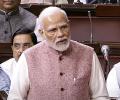
The Congress MPs have given adjournment notices in both houses of Parliament to discuss the border situation with China.

Border personnel meeting between Chinese and Indian border troops was held on the Chinese side near Bumla in Tawang district of Arunachal Pradesh.

The incident, involving a Chinese patrol, occurred in Arunachal Pradesh, on June 26, 2003.
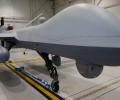
The MQ-9B predator armed drones -- 10 each for three services -- is seen to be a key part of India's national security and defense needs.

'India has to prepare for future warfare where kinetic use of force at the border will be limited. War will take place in the realms beyond the border.'

The resolution was introduced by Senator John Cornyn, Republican Senate Majority Whip, and Senator Mark Warner, ranking member of the Senate Select Committee on Intelligence.
'After more than 20 years of understanding, nothing much seems to have been achieved. What the two countries have been trying to do is to manage the recurrence of border incursions. The two sides must address the disease, and not the symptom of the disease,' says Rup Narayan Das.

The marathon fourth round of Lt Gen-level talks also focussed on steps for pulling back large number of troops and weapons from rear bases along the Line of Actual Control in eastern Ladakh.

The government has also relaxed certain rules to cut delays in military purchase like allowing the three services to procure required weapons and equipment from a single vendor, the sources said.

'It's a very tough situation. We're talking to India. We're talking to China. They've got a big problem there'

Chinese Foreign Minister Qin Gang will travel to India to attend the meeting of G20 foreign ministers on March 2, during which he is expected to hold his first bilateral meeting with External Affairs Minister S Jaishankar.

In the confrontation in Doklam, where Indian and Chinese soldiers were lined up eyeball-to-eyeball, senior Indian commanders recount they could sense the uncertainty in the Chinese. While Indian soldiers had to be restrained from pushing the Chinese troops back, our chief interpreter heard the Chinese officers threatening to open fire on PLA soldiers who wavered or withdrew, reveals Ajai Shukla.

'What's sad today is that there are so many people who cannot find work, not because the country is devoid of that opportunity, but because we are not doing enough in the country.'

Prime Minister Narendra Modi's bilateral meetings on the sidelines of the BRICS summit in Johannesburg are being finalised, Foreign Secretary Vinay Kwatra said on Monday but did not give a direct reply on the possibility of a meeting between Modi and Chinese President Xi Jinping.

Prime Minister Modi and President Xi held the conversation on Wednesday on the sidelines of the BRICS (Brazil, Russia, India, China, South Africa) summit in Johannesburg.
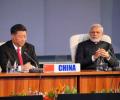
'Under General Secretary of the Chinese Communist Party (CCP) Xi Jinping, Beijing has stepped up its aggressive foreign policy toward New Delhi. Since 2013, China has engaged in five major altercations with India along the Line of Actual Control (LAC),' said a brief issued by US-China Economic and Security Review Commission.
'The supreme art of war is to subdue the enemy without fighting' said the famed ancient Chinese military strategist Sun Tzu. That seems to be the ploy behind the Chinese intrusion in Ladakh, says Colonel (retd) R Hariharan
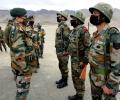
India and China have held several rounds of talks at the diplomatic and military-level to resolve the standoff that erupted in early May.

Prime Minister Narendra Modi and Chinese President Xi Jinping shook hands on Tuesday at a side event at the G20 Summit in Bali, a gesture drawing some attention because of the strained relations between the two countries over a border clash two years back.

The Centre's interlocutor and retired IPS officer RN Ravi has been shifted from Nagaland to Tamil Nadu as its new governor.

He said India had made matching deployments in terms of troops and infrastructure in its areas along the LAC and there was no way anyone would be able to behave in an aggressive manner again.

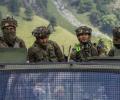
Two days after the India-China military talks, the joint statement, issued in New Delhi by the Indian Army said both sides had a 'candid and in-depth exchange' relating to disengagement along the Line of Actual Control (LAC) in the Western Sector of India-China border areas.

The meetings were organised on Sunday at Nathu La in Sikkim and Bum La and Kibithu in Arunachal Pradesh, he said.
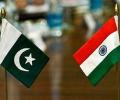
What does a flag meeting mean? Air Marshal B K Pandey explains
The two sides have already held seven rounds of Corps Commanders level talks to discuss the entire issue of transgressions in the Eastern Ladakh sector.

The two sides have also agreed for a joint mechanism to verify the progress in the disengagement process through delegation meetings as well as using unmanned aerial vehicles.
 © 2026 Rediff.com - Advertise with us - Disclaimer - Privacy Policy - Sitemap - Feedback - About us - Terms of use - Grievances